Back | Home | UMMZ Acari
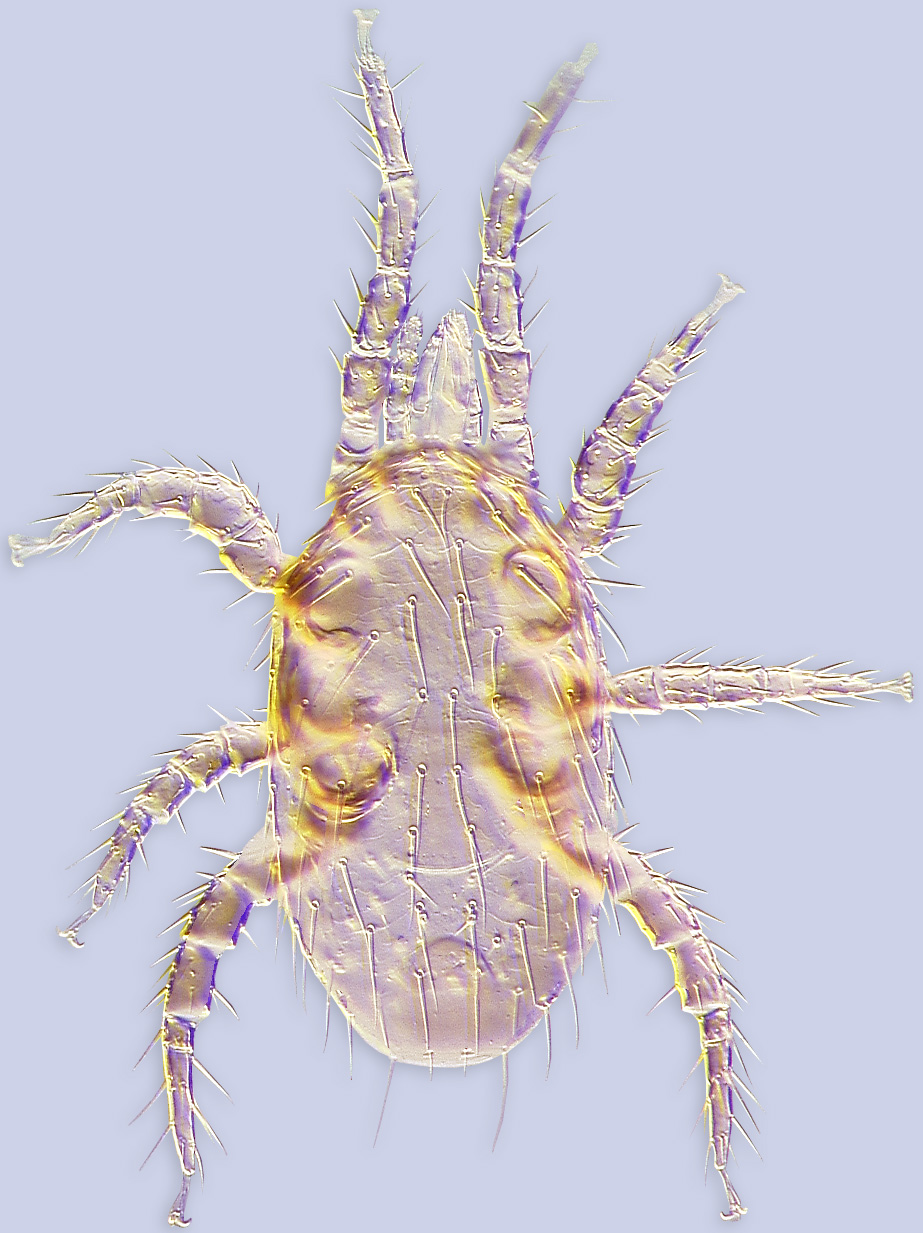
Family Ascidae Oudemans, 1905
This family is distributed worldwide and includes 34 genera. Ascid mites live in soil, leaf litter, subcortical situations and are often associated with other animals (Halliday et al., 1998). The mites are mostly predators, but also can feed on fungal mycelium; some are parasitic. Several species of the genus Proctolaelaps are obligatory associates of bumblebees. The genera Lasioseius and Blattisocius were recorded from beehives in North America and the Old World (Basha and Yousef, 2001; Bregetova, 1977; Chinniah and Mohanasundaram, 1995; Crozier, 1989; Haragsim et al., 1978). In addition, Melichares agilis Hering, 1838 was found in beehives in Europe (Haragsim et al., 1978).
Key to genera of the family Ascidae found on bees or their nests
adults
(modified from Halliday et al., 1998)
1. Fixed digit of chelicera with membranous pilus dentilis. Peritrematal shield at level of stigma usually less than twice as wide as diameter of stigma. On ventral opisthosoma, usually only anal shield with 3 circumanal setae present. Female epigynial shield usually rounded posteriorly ... 2
- Fixed digit of chelicera with filiform pilus dentilis. Peritrematal shield at level of stigma at least twice as wide as diameter of stigma or shorter. Ventrianal shield usually present, with 2-7 pairs of ventral setae in addition to circumanal setae. Female epigynial shield usually truncate posteriorly ... 3
2(1) Adults with 1-4 pairs of posterior marginal setae (R) on soft ventro-lateral cuticle, all others on edge of dorsal shield; female with 18-22 pairs of setae on opisthonotal region of dorsal shield; female usually with metasternal plates ... Proctolaelaps
- Adults with 7-13 pairs of marginal (r-R) setae on soft lateral cuticle (rarely fewer if some r-R setae lacking); female with 14-15 pairs of setae on opisthonotal region of dorsal shield; female lacking metasternal plates ... Melichares
3(2) Corniculi narrowly separated, usually slender; tectum convex, smooth; fixed digit of chelicera with few or no teeth; peritrematal shield slender, barely wider than stigma at level of stigma; female with humeral seta (r3) usually on soft cuticle beside dorsal shield ... Blattisocius
- Corniculi well separated, stout; tectum convex, smooth or denticulate; fixed digit of chelicera usually with many teeth; peritrematal shield clearly wider than diameter of stigma at level of stigma; female with humeral setae on dorsal shield ... Lasioseius
Genus Proctolaelaps Berlese, 1923
Proctolaelaps Berlese, 1923: 255 (type species Proctolaelaps productus Berlese, 1923 by monotypy); Halliday et al., 1998 (their synonymy).
Garmania (Garmaniella) Westerboer, 1963: 411 (type species Garmania (Garmaniella) longisetosa Westerboer, 1963 by original designation). Synonymized by Lindquist and Evans (1965).
Proctolaelaps includes nearly 90 described species. They occur in association with bark beetles, bumblebees and other insects, in nests of birds and mammals, in flowers visited by hummingbirds, in various decaying organic substances, or are synanthropic. Some species feed on small arthropods (including acarid mites), nematodes, fungi, or pollen (Nawar, 1992). Adults of other species are phoretic on insects, although Proctolaelaps nauphoetae (Womersley, 1956) is parasitic in all instars on cockroaches (Egan and Moss, 1969). Many species are cosmopolitan (Halliday et al., 1998).
Five species were recorded in association with nests of bumblebees or phoretic on the adult insects in Europe, Siberia, and Kuril Islands (Davydova, 1988; Karg, 1971; Klimov, 1998; Westerboer, 1963). We have seen Proctolaelaps longisetosus (=P. novineus El-Banhawy et Nasr, 1986, syn. n. described originally from an Apis mellifera hive in New York) and three other Palaearctic species from nests of bumblebees in North America. Proctolaelaps pygmaeus, a widespread species living in a variety of habitats, including honeybee hives, is also given in the key below.
Key to species of the genus Proctolaelaps found on bees and bee nests in North America
females
1. Fixed digit of chelicera with 1-2 teeth. Anus smaller, not exceeding height of tibia IV. Posterior edge of anus placed in anterior half of anal shield ... 2
- Fixed digit of chelicera with numerous teeth. Anus large, exceeding height of tibia IV. Posterior edge of anus placed in posterior half of anal shield ... 4
2(1) Postanal and anal setae subequal. Dorsal idiosoma coarsely sculptured, with pattern forming 3 impressed longitudinal rows. Dorsal setae short distinctly not reaching bases of subsequent setae. Anal shield length and width almost equal ... Proctolaelaps ornatus
- Postanal seta distinctly longer than anal setae. Dorsal idiosoma not coarsely sculptured, without 3 impressed longitudinal rows. Dorsal setae longer, exceeding or almost reaching bases of subsequent setae. Anal shield distinctly longer than width ... 3
3(2) Dorsal idiosomal setae exceeding bases of subsequent setae approximately by 1/3 of their length. Setae J1-4 longer than 60 micrometers... Proctolaelaps longisetosus
- Dorsal idiosomal setae not exceeding bases of subsequent setae or if exceeding then less than by 1/3 of their length. Setae J1-4 shorter than 60 micrometers ... Proctolaelaps bombophilus
4(1) Anterior hypostomal setae not wider than other hypostomal setae. Anal and epigynial shield narrowly separated. Corniculi directed inward Proctolaelaps longanalis
- Anterior hypostomal setae distinctly wider than other hypostomal setae. Anal and epigynial shield well separated. Corniculi almost parallel to each other ... Proctolaelaps pygmaeus
Proctolaelaps longanalis (Westerboer, 1963)
Garmania (Garmania) longanalis Westerboer, 1963: 398, Figs 239-241.
Proctolaelaps longanalis: Karg, 1971: 241, Figs 258h, 263a.
Melichares longisetosus: Bregetova, 1977: 213, Figs 134,4-7.
Material examined. 5 females from R.W. Husband's collection (not processed).
Biology. This species was known only from bumblebee and rodent nests in Europe (Bregetova, 1977; Westerboer, 1963). We have seen a small series of females collected from adult bumblebees in North America.
Distribution. USA (first record): Michigan; Germany (type locality); Ukraine (Bregetova, 1977; Westerboer, 1963).
Hosts. North America:
Bombus (Fervidobombus) pensylvanicus (De Geer, 1773) (as americanorum) (first record)
Bombus (Fervidobombus) fervidus (Fabricius, 1798) (first record)
Bombus (Pyrobombus) bimaculatus Cresson, 1863 (first record)
Palaearctic region:
Bumblebee nest, rodent nest (Bregetova, 1977; Westerboer, 1963).
Proctolaelaps pygmaeus (Müller, 1859)
Gamasus pygmaeus Müller, 1859: 30.
Proctolaelaps pygmaeus: Karg, 1971: 242, Figs 257b, 257h, 258l, 263b; Bregetova, 1977: 213, Fig. 135; Halliday et al., 1998: 37, Fig. 29 (their synonymy)
Biology. Proctolaelaps pygmaeus was collected in a very wide range of habitats, including soil, stored food, bulbs, laboratory insect cultures, plant roots, decomposing plant material, under bark, in subterranean nests of small mammals, birds and in beehives. It may be predatory on small arthropods, but is also a fungivore, and unlike most ascid mites, it is able to ingest solid matter. There is circumstantial evidence that it can attack humans and that the results can be severe enough to cause extensive papular dermatosis (Halliday et al., 1998; Haragsim et al., 1978). In North America, this mite has not been found on bees or in bee nests.
Distribution. USA; Canada; localities outside North America include Palaearctic, Oriental, Afrotropic, Neotropic, and Australian regions (Casanueva et al., 1994; Bregetova, 1977; Haragsim et al., 1978; Karg, 1971; Raut and Bhattacharya, 1999; Westerboer, 1963).
Proctolaelaps longisetosus (Postner in Westerboer, 1963)
Garmania (Garmaniella) longisetosa Postner in Westerboer, 1963: 420, Figs 255-260.
Garmaniella longisetosa: Karg, 1971: 244, Figs 258o, 264a.
Melichares longisetosus: Bregetova, 1977: 221, Figs 140,3, 144; Klimov: 1998: 12.
Proctolaelaps novineus El-Banhawy and Nasr, 1986: 77, Figs 11-19, syn. n.
Material examined. 6 females, 7 males, 5 deutonymphs - USA: Ohio, Franklin Co., Columbus, nest of Bombus (Fervidobombus) fervidus (Fabricius, 1798), 6 Jul 2002, J. Wenzel, BMOC 02-0706-001; 11 additional slides from R. W. Husbands' collection (unprocessed).
Biology. This species is found on adult bumblebees and their nests (see below) and in subterranean nests of rodents (Bregetova, 1977; Westerboer, 1963).
Distribution. USA: Michigan (first record), New York, Ohio (first record); Germany (type locality); Ukraine; Russia: Moskovskaya Oblast', Orenburgskaya Oblast', Udmurtiya, Western Siberia, Kuril Islands (Bregetova, 1977; Davydova and Bogatyrev, 1990; El-Banhawy and Nasr, 1986; Klimov, 1998; Westerboer, 1963)
Hosts. North America:
Apis mellifera Linnaeus, 1758
Bombus (Bombias) auricomus (Robertson, 1903) (first record)
Bombus (Bombus) affinis Cresson, 1863 (first record)
Bombus (Fervidobombus) fervidus (Fabricius, 1798) (first record)
Bombus (Fervidobombus) pensylvanicus (De Geer, 1773) (as americanorum) (first record)
Bombus (Pyrobombus) impatiens Cresson, 1863 (first record)
Palaearctic region:
Bombus (Bombus) lucorum (Linnaeus, 1761)
Bombus (Bombus) terrestris (Linnaeus, 1758)
Bombus (Megabombus) hortorum (Linnaeus, 1761)
Bombus (Megabombus) ruderatus (Fabricius, 1775)
Bombus (Melanobombus) lapidarius (Linnaeus, 1758)
Bombus (Pyrobombus) hypnorum (Linnaeus, 1758)
Bombus (Pyrobombus) pratorum (Linnaeus, 1761)
(El-Banhawy and Nasr, 1986; Karg, 1971; Westerboer, 1963; our data)
Note. Type host is not indicated in the original description.
Proctolaelaps bombophilus (Postner in Westerboer, 1963)
Garmania (Garmaniella) bombophila Postner in Westerboer, 1963: 416, Figs 252-254.
Garmaniella bombophila: Karg, 1971: 244, Figs 257i, 258p, 264b.
Melichares bombophila: Bregetova, 1977: 222, Figs 142,2,7-10.
Melichares bombophilus: Klimov, 1998: 13.
Material examined. - 3 females (including 1 female in bad shape from Sweden) and 1 male from R. W. Husbands' collection (unprocessed).
Biology. This species is found so far in nests of bumblebees, and also in nests of rodents, including squirrels (Bregetova, 1977; Westerboer, 1963). One specimen was collected phoretic on a bumblebee (our data). Mites from North America were found on brood and dead female inside nest.
Distribution. Canada: Alberta (first record); USA: Michigan (first record); Germany (type locality); Sweden (first record); Russia: Moskovskaya Oblast', Western Siberia, Kuril Islands (Bregetova, 1977; Davydova and Bogatyrev, 1990; Klimov, 1998; Westerboer, 1963; our data)
Hosts. North America: Bombus (Bombus) terricola Kirby, 1837 (as occidentalis) and Bombus (Fervidobombus) fervidus (Fabricius, 1798) (as californicus); Europe: Bombus sp., Bombus (Bombus) albocinctus Smith, Bombus (Confusibombus) confusus Schenck, 1859 (as "conficius") (first record).
Note. Our mites well agree with the original description (Westerboer, 1963), except for movable digit of chelicera with one tooth (two in P. bombophilus from Europe) and apices of corniculi less pointed. The species is identified tentatively. Comparison with European material is necessary.
Proctolaelaps ornatus (Postner in Westerboer, 1963)
Garmania (Garmaniella) ornata Postner in Westerboer, 1963: 426, Figs 261-263.
Garmaniella ornata: Karg, 1971: 244, Figs 258r, 264d.
Melichares ornata: Bregetova, 1977: 218, Figs 142,1,3-6.
Melichares ornatus: Klimov: 1998: 12.
Material examined. 1 female, 1 deutonymphs - USA: Ohio, Franklin Co., Columbus, nest of Bombus (Fervidobombus) fervidus (Fabricius, 1798), 6 Jul 2002, J. Wenzel, BMOC 02-0706-001; 8 additional slides from R. W. Husbands' collection (unprocessed).
Biology. This species is found on adult bumblebees and their nests (see below) and in subterranean nests of rodents (Bregetova, 1977; Westerboer, 1963).
Distribution. USA: Michigan (first record), Ohio (first record); Canada (Alberta) (first record); Germany (type locality); Ukraine; Russia: Kuril Islands (Bregetova, 1977; Davydova and Bogatyrev, 1990; El-Banhawy and Nasr, 1986; Klimov, 1998; Westerboer, 1963)
Hosts. North America:
Bombus (Fervidobombus) fervidus (Fabricius, 1798) (first record)
Bombus (Fervidobombus) pensylvanicus (De Geer, 1773) (as americanorum) (first record)
Bombus (Pyrobombus) bifarius Cresson, 1878 (first record)
Bombus (Pyrobombus) bimaculatus Cresson, 1863 (first record)
Bombus (Pyrobombus) ternarius Say, 1837 (first record)
Bombus (Pyrobombus) vagans Smith, 1854 (first record)
Bombus (Subterraneobombus) borealis Kirby, 1837 (first record)
Palaearctic region:
Bombus (Bombus) terrestris (Linnaeus, 1758)
Bombus (Melanobombus) lapidarius (Linnaeus, 1758)
Bombus (Bombus) lucorum (Linnaeus, 1761)
Bombus (Megabombus) hortorum (Linnaeus, 1761)
Bombus (Pyrobombus) hypnorum (Linnaeus, 1758)
Bombus (Megabombus) ruderatus (Fabricius, 1775)
Bombus (Bombus) albocinctus Smith
Bombus (Megabombus) tichenkoi (Skorikov, 1925)
(Klimov, 1998; Westerboer, 1963; our data)
Note. Type host is not indicated in the original description.
Genus Lasioseius Berlese, 1916
Lasioseius Berlese, 1916: 34 (type species Seius musicatus [lapsus pro muricatus] Berlese, 1887 (non Koch, 1839) (=Typhlodromus berlesei Oudemans, 1938) by original designation) (part.); Halliday et al., 1998: 24 (their synonymy).
Lasioseius, with approximately 100 described species, is probably the most morphologically diverse genus of Ascidae (Halliday et al., 1998). Species of this genus were found on rotting organic substances, in forest litter, moss, soil, in nests of small mammals and birds, under bark, in bracket-fungi, tree-holes, stored products, in warehouses, and hay. Two species were collected in beehives: Lasioseius penicilliger Berlese, 1916 in Canada and former Czechoslovakia (Crozier, 1989; Haragsim et al., 1987) and Lasioseius furcisetus Athias-Henriot, 1959 in the Western part of the former USSR (Bregetova, 1977). There is no evidence, however, that beehives are their primary habitat.
Lasioseius penicilliger Berlese, 1916
Lasioseius (Zercoseius) penicilliger Berlese, 1916: 44;
Lasioseius penicilliger: Evans, 1958: 219, Fig. 68; Bregetova, 1977: 180, Figs 106,3.
Biology. The species was found in decaying wood, old grassland and fields, in soil, nests of mammals and birds, in mills, on damp barley, and in beehives. The records from beehives are probably occasional. No harm to the bees was reported. Hughes (1976) speculates that this species might feed on mould.
Distribution. Canada: Nova Scotia; Mexico; British Isles; Italy (type locality); Germany; former Czechosovakia (Crozier, 1989; Estebanes-Gonzalez, 1997; Haragsim et al., 1987; Hughes, 1976; Bregetova, 1977).
Genus Blattisocius Keegan, 1944
Blattisocius Keegan, 1944: 181. Type species Blattisocius triodons Keegan, 1944 by original
designation (= Lasioseius tarsalis Berlese, 1918); Halliday et al., 1998 (their synonymy).
Blattisocius comprises at least 10 species, most of which are widespread predators in soil, insect cultures and stored food, and on plants. One species, Blattisocius patagiorum Treat, 1966, is parasitic on adult noctuid moths (Halliday et al., 1998). Blattisocius tarsalis (Berlese, 1918) was found in honeybee hives in North America (Crozier, 1989). This and three others species, Blattisocius dentriticus (Berlese, 1918), Blattisocius apisassociae Chinniah et Mohanasundaram, 1995, and Blattisocius apis Basha et Yousef, 2001 were recorded from the same habitat in the Old World (Banaszak, 1980; Basha and Yousef, 2001; Chinniah and Mohanasundaram, 1995; Haragsim et al., 1978).
Blattisocius tarsalis (Berlese, 1918)
Lasioseius (Lasioseius) tarsalis Berlese, 1918: 134.
Melichares (Blattisocius) tarsalis: Evans, 1958: 209, Figs 48-49.
Blattisocius tarsalis: Weserboer and Berhard, 1963; Karg, 1971: 191, Figs 205a, 209a; Bregetova, 1977: 226, Fig. 149;
Biology. This species commonly occurs is synanthropic habitats (hay, stored products). In Western Australia, it was found on larvae and pupae of the greater wax moth Galleria mellonella (Linnaeus, 1758) in beehive (Halliday et al., 1998); Crozier (1989) reports it from honey bee hives in Canada. In North America, it was also recorded from cultures of various stored product insects: Sitotroga cerealella (Olivier, 1789) (Lepidoptera: Gelechiidae), Tineola biselliella (Hummel, 1823) (Lepidoptera: Tineidae), Ephestia elutella (Hübner, 1796) (Lepidoptera: Pyralidae); Tribolium confusum Jacquelin du Val, 1863, Tribolium castaneum (Herbst, 1797) (Coleoptera: Tenebrionidae), Attagenus piceus Latreille, 1804 (Coleoptera: Dermestidae). It was shown that Blattisocius tarsalis could control the size of the Mediterranean Flour Moth (Ephestia kuehniella Zeller, 1879) populations in specific conditions (depth of grain); the mites consumed the insect eggs and were phoretic upon the adult moths. Blattisocius tarsalis may be a parasitic species, Treat (1975) noticed attacks of the female mites on full grown larvae of the moth Idia aemula (Hübner, 1813) (Lepidoptera: Noctuidae). He also lists this species of moth, as well as Apamea devastator Brace, 1819 (Noctuidae) and Aglossa costiferalis (Walker, 1866) (Pyralidae) as phoretic hosts for Blattisocius tarsalis in the United States. The mite life span from egg to egg is approximately ten days.
Distribution. Nearctic (including the United States and Canada), Palaearctic (Italy is the type locality), Oriental, and Australian regions (Berlese, 1918; Bhattacharyya and Sanyal, 2002; Karg, 1971)
References
Banaszak J. 1980. [Investigations of the fauna associated in bee-hives]. Fragmenta Faunistica. 25(10): 127-177.
Berlese A. 1918. Centuria quarta di Acari nuovi. Redia. 13: 115-192.
Berlese A. 1923. Centuria sesta di Acari nuovi. Redia. 15: 237-262.
Bhattacharyya A. K., Sanyal A. K. 2002. New data on mites of the genera Asca and Blattisocius (Mesostigmata, Ascidae) in India along with the description of Asca annandalei sp. n. Acarina. 10(2): 167-173.
Bregetova, N. G. 1977. [Family Aceosejidae]. In: M. S. Gilarov and N. G. Bregetova [Eds] [Opredelitel' obytayshchikh v pochve kleshchey Mesostigmata = Identification key to soil-inhabiting mites Mesostigmata]. Nauka: Leningrad. 169-226.
Casanueva, M. E., Berrios A. M., Peredo A. A., Martinez R. I. 1994. Acaros asociados a equinos estabulados 1. Androlaelaps casalis (Berlese), Haemogamasus horridus Michael y Proctolaelaps pygmaeus (Muller), primer registro para Chile y redescripcion de los machos (Acari: Mesostigmata). Gayana Zoologia. 58(1): 61-69.
Chinniah C., Mohanasundaram M. 1995. Record of new ascid mites (Ascidae: Acari) infesting insects in Tamil Nadu, India. Entomon. 20(3-4): 233-236.
Crozier L. 1989. Melittiphis alvearius (Berlese) and other mites found in honeybee colonies in Nova Scotia. Journal of Apicultural Research. 28(3): 166-168.
Davydova M. S. 1988. [New species of gamasid mites associated with bumble bees]. Novye i Maloizvestnye Vidy Fauny Sibiri. 20: 18-32.
Davydova M.S. and Bogatyrev N. R. 1990. [The fauna and several peculiarities of ecology of gamasid mites associated with bumblebees]. In: G. S. Zolotarenko [Ed.]. Chlenistonogie i gelminty. Nauka: Novosibirsk. P. 27-33. (In Russian)
De Jong, D., Morse R. A. and Eickwort G. C. 1982. Mite pests of honey bees. Annual Review of Entomology. 27: 229-252.
Egan M. E. and Moss W. W. 1969. The life cycle and behavior of a cockroach mite, Proctolaelaps nauphoetae (Acari: Mesostigmata: Ascidae). Notulae Naturae. 420: 1-9.
Eickwort G. C. 1988. The origin of mites associated with honey bees. In: G. R. Needham, R. E. Page, M. Delfinado-Baker, C. E. Bowman [Eds.]. Africanized honey bees and bee mites. Ellis Hordwood Limited: Chichester. 327-338.
El-Banhawy E. M., Nasr, A. K. 1984(1986). Incidence of mites in bee hives in the State of New York with descriptions of two new species. Bulletin of Zoological Society of Egypt. 34: 76-82.
Estebanes-Gonzalez M. L. 1997. Acarofauna en nidos de aves silvestres en Mexico. Acta Zoologica Mexicana Nueva Serie 71: 1-15.
Evans G. O. 1958. A revision of the British Aceosejinae (Acarina: Mesostigmata). Proceedings of the Zoological Society of London. 131(2): 177-229.
Garrido, C. y M. E. Casanueva. 1995. Acaros foréticos e hiperforéticos sobre Bombus dahlbohmi Guerin, 1835 (Hym., Apidae). Bol. Soc. Biol. Concepción, Chile. Tomo 66: 53-55.
Halliday R. B., Walter D. E., Lindquist E. E. 1998. Revision of the Australian Ascidae (Acarina : Mesostigmata). Invertebrate Taxonomy. 12(1): 1-54.
Haragsim O., Samsinak K., Vorbazkova E. 1978. The mites inhabiting the bee hives in CSR. Zeitschrift für angewandte Entomologie. 87: 52-67.
Hughes, A. M. (1976). The mites of stored food and houses. Ministry of Agriculture, Fisheries and food - Technical Bulletin No 9. Her Majesty's Stationery Office: London. 1-400 p.
Karg W. 1971. Acari (Acarina), Milben. Unterordnung Anactinochaeta (Parasitiformes). Die freilebenden Gamasina (Gamasides), Raubmilben. Die Tierwelt Deutschlands. 59. pp 1-475.
Karg, W. 1988. Zur Kenntnis der Gattung Proctolaelaps Berlese, 1923 (Acarina, Parasitiformes). Zoologische Jahrbücher Abteilung für Systematik Ökologie und Geographie der Tiere. 115(4): 441-454.
Keegan H. L. 1944. On a new genus and species of parasitid mite. Journal of Parasitology. 30: 181-183.
Klimov P. B. 1998. To the knowledge of mites and ticks (Acari) of Kuril Islands. Far Eastern Entomologist. 63:1-36.
Lindquist E. E. and Evans G. O. 1965. Taxonomic concepts in the Ascidae, with a modified setal nomenclature for the idiosoma of the Gamasina (Acarina: Mesostigmata). Memoirs of the Entomological Society of Canada. 47: 1-64.
Nawar M. S. 1992. Life tables of Proctolaelaps deleoni Nawar, Childers and Abou-Setta (Gamasida: Ascidae) at different temperatures. Experimental and Applied Acarology. 13(4): 281-285.
Oudemans A. 1938. Nieuwe vondsten op het gebied der Systematiek en der Nomenclatuur der Acari mede. Tijdschrift voor Entomologie. 81: II-X.
Raut S. K., Bhattacharya S. S. 1999. Pests and diseases of betelvine (Piper betle) and their natural enemies in India. Experimental and Applied Acarology. 23(4): 319-325.
Treat. A. E. 1975. Mites of moths and butterflies. Cornell University Press: Ithaca, New York. 262 p.
Westerboer I. 1963. Die Familie Podocinidae Berlese 1916. In: H. J. Stammer [Ed.]. Beiträge zur Systematik und Ökologie Mitteleuropäischer Acarina. Band II. Mesostigmata 1. Akademische Verlagsgesellschaft Geest & Portig K.-G.: Leipzig. 179-450.
Westerboer I., Bernhard F. 1963. Die Familie Phytoseiidae Berlese 1916. In: H. J. Stammer [Ed.]. Beiträge zur Systematik und Ökologie Mitteleuropäischer Acarina. Band II. Mesostigmata 1. Akademische Verlagsgesellschaft Geest & Portig K.-G.: Leipzig. 451-793.
B. OConnor and P. Klimov ©
Created: Apr 09, 2004
Last modified: