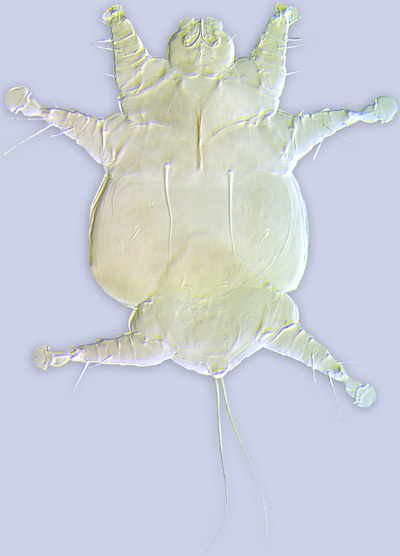
mite Locustacarus buchneri (Podapolipidae), larviform female
Fig. 1.Locustacarus buchneri (Podapolipidae): larvifrom female, dorsal view Click here to enlarge
Back | Home | UMMZ Acari


Family Podapolipidae Oudemans, 1931


This family includes at least twenty-five genera of internal or external arthropod parasites which often display reductions in numbers of legs and gnathosomal structures. One species is associated with bees.
Notes. The genitive case of the Latin word polipus (variant of polypus) is polipi (polypi), thus the family name should be Podapolipidae, not Podapolipodidae.

Genus Locustacarus Ewing, 1924


Locustacarus Ewing, 1924: 67 (Type species Locustacarus trachealis Ewing, 1924 by monotypy).
Bombacarus Stammer, 1951: 138 (Type species Bombacarus buchneri Stammer, 1951 by monotypy). Synonymized by Husband and Sinha, 1970.

The genus includes three species. Locustacarus trachealis and L. masoni Husband, 1974 occur in the respiratory system of their orthopteran hosts apparently piercing the tracheal walls to feed. Locustacarus buchneri is an internal parasite of bumblebees (Husband, 1974; Husband and Sinha, 1970).

Locustacarus buchneri(Stammer, 1951)

Bombacarus buchneri Stammer, 1951: 138, Figs 1-7; Husband, 1969: 287.
Locustacarus buchneri: Husband and Sinha, 1970: 1157, Figs 7-13 (Their synonymy).

Material examined. 2 physogastric females, 1 larval female exoskeleton - USA: Michigan, Kalamazoo Co., Gull Lake Biological Station, metasomal air sacks of Bombus bimaculatus, 24 Jun 1965, R. W. Husband RWH 24VI65-1, UMMZ BMOC 04-0402-002; physogastric female - USA: Michigan, Allegan Co., Allegan State Forest [label reads Allegan State Park], T25, R14W,S28, metasomal air sacks of Bombus bimaculatus, 24 Jun 1965, R. W. Husband RWH 29VII65-1, UMMZ BMOC 04-0402-003; larval female - USA: Michigan Berrien Co., Fernwood Arboretum, left metasomal air sacks of Bombus bimaculatus queen, 29 Jul 1965, R. W. Husband RWH 3VI94-2, UMMZ BMOC 04-0402-004; larval female - USA; Michigan, Lenawee Co., Adrian, Bombus bimaculatus (worker cought entering underground nest), 23 Jul 03, R. W. Husband RWH 2VII03-01, UMMZ BMOC 04-0402-006; larvoform female - JAPAN: Shiga Village, tracheal air sacks of Bombus consobrinus, 9 Jul 1990, Matsumoto RWH 9VII90-1, UMMZ BMOC 04-0402-001; male - INDIA: Jammu and Kashmir: Gulmarg, 2700 m., metasomal air sacks of Bombus tunicatus, 1985-1986, P. H. Williams RWH 85-86-1, UMMZ BMOC 04-0402-005.
Biology. Locustacarus buchneri is an internal parasite of bumblebees occurring in tracheae and air sacs. Husband and Sinha (1970) reconstructed its life cycle. In the late April, the queen of Bombus bimaculatus emerges from overwintering sites in the soil. Within a few days, female mites in the tracheae enlarge as the haemolymph is ingested and ovaries begin to function. Several female mites may be found in tracheae of each queen bee. Nearly one week after emergence of a queen bee, eggs hatch. As many as 50 eggs were associated with a single female mite. Paired male and larviform female mites may be found among the eggs. In some cases the sex ratio of young mites is near unity. Some females may have been unfertilized and may produce only males. Males have poorly developed mouthparts, are short lived, and do not leave the host bee. Larviform female mites migrate to the tracheae of worker bees, attach to the tracheal walls, molt, and begin to enlarge. Adult females with only two legs and a greatly distended body cannot leave the host. This cycle may be repeated several times during the next eight weeks. In the first week in July, male bees and new queen bees emerge. Males of Psithyrus spp., B. vagans, and other B. bimaculatus occasionally enter the nest and may bring in or take out larviform female mites in the tracheae. By early August, new queen bees have mated, left the nest, and some may have entered diapause at sites several inches below the ground. After the new queen bees leave the nest, few new workers are produced and older workers accumulate more and more mites. The numbers of mites in worker and male bees in August is sufficient to severely injure the bees. Diarrhea is observed and some bees are lethargic and no longer forage. It was at this time that a small male mite was found. This observation is slight evidence that small males may be produced by crowding of mites, poor nutrition, or by aging of the parent. Because worker bees, male bees, and the old queen bee die during fall, the only mites which survive to the following April are in the tracheae of young queens in diapause.
Goka et al., 2001 reported introduction of this species to Japan with commercially breeding Bombus terrestris from Belgium and Netherlands.
Distribution. Canada: Manitoba; USA: Michigan, Colorado, Missouri, Virginia, Kansas; England; Belgium; Netherlands; France, Germany; former Czechoslovakia; Denmark; Sweden; Poland; Russia; Japan; India (Eidelberg, 1994; Husband & Husband, 1996; Husband and Sinha, 1970; Goldblatt & Fell, 1984; Goka et al., 2001; Goka et al., 2002).
Distribution. The type locality and host are uncertain because the holotype has not been designated and multiply localities and hosts have been reported in the original description. Localities (original order): Franken, Mecklenburg (Germany), Tirol (France). Hosts (original order): Bombus pratorum, B. barbutellus (in Psithyrus), B. sylvarum, B. pascuorum (as agrorum), B. hortorum, B. lapidarius, B. terrestris, B. lucorum, B. ruderarius (as derhamellus), B. veteranus (as equestris), B. campestris (in Psithyrus), B. vestalis (in Psithyrus).
Hosts.
Holarctic:
Bombus (Alpinobombus) balteatus Dahlbom, 1832
Bombus (Bombus) terricola Kirby, 1837
Bombus (Psithyrus) citrinus (Smith, 1854), reported as "Psythyrus laboriosus F."
Bombus (Pyrobombus) bimaculatus Cresson, 1863
Bombus (Pyrobombus) perplexus Cresson, 1863
Bombus (Pyrobombus) vagans Smith, 1854

Palaearctic:
Bombus (Alpinobombus) balteatus Dahlbom, 1832
Bombus (Alpinobombus) polaris Curtis, 1835
Bombus (Bombus) hypocrita Pérez, 1905
Bombus (Bombus) ignitus Smith, 1869
Bombus (Bombus) lucorum (Linnaeus, 1761)
Bombus (Bombus) terrestris (Linnaeus, 1758)
Bombus (Bombus) tunicatus Smith, 1852
Bombus (Megabombus) consobrinus Dahlbom, 1832
Bombus (Megabombus) hortorum (Linnaeus, 1761)
Bombus (Melanobombus) lapidarius (Linnaeus, 1758)
Bombus (Psithyrus) barbutellus (Kirby, 1802)
Bombus (Psithyrus) campestris (Panzer, 1801)
Bombus (Psithyrus) vestalis (Geoffroy, 1785)
Bombus (Pyrobombus) hypnorum (Linnaeus, 1758)
Bombus (Pyrobombus) pratorum (Linnaeus, 1761)
Bombus (Thoracobombus) pascuorum (Scopoli, 1763) reported as "B. agrorum (Fabricius, 1787)"
Bombus (Thoracobombus) ruderarius (Müller, 1776) reported as "B. derhamelus K."
Bombus (Thoracobombus) sylvarum (Linnaeus, 1761)
Bombus (Thoracobombus) veteranus (Fabricius, 1793) reported as "Bombus equestris F."
(Husband & Husband, 1996; Husband and Sinha, 1970; Goka et al., 2001; Goldblatt & Fell, 1984; Stammer, 1951)

References
Eidelberg M. M. 1994. Mites of the family Podapolipidae (Heterostigmata, Tarsonemina) of Ukraine and adjacent areas with description of a new species. Vestnik Zoologii. 1: 37-43.
Ewing H. E. 1924. New tarsonemid mites (order Acarina, Family Tarsonemidae). Proceedings of Entomological Society of Washington. 26(3): 66-69.
Goka K., Okabe K., Yoneda M., Niwa S. 2001. Bumbleebee commercialization has caused international migration of parasitic mites. Molecular Ecology. 10: 2095-2099.
Goka K., Okabe K., Yoneda M., Niwa S. 2002. Bumbleebee commercialization has caused international migration of parasitic mites. XI International Congress of Acarology. Program and abstract book. Merida, Yucatan, Mexico, 8-13 Sept., 2002. Univesidad Nacional Auton—mia de México. p. 75.
Goldblatt J. W., Fell R. D. 1984. Parasites and parasitization rates in bumble bee queens, Bombus spp. (Hymenoptera: Apidae), in Southwestern Virginia. Environmental Entomology. 13(6): 1661-1665.
Goldblatt J. W., Fell, R. D. 1984. Parasites and parasitization rates in bumble bee queens, Bombus spp. (Hymenoptera: Apidae), in southwestern Virginia. Environmental Entomology 13(6): 1661-1665.
Husband R. W. 1969. Bombacarus buchneri (Acarina: Podapolipodidae) in North America. Proceedings of the 2nd International Congess of Acarology. Sutton Bonington, England, 19-25 July, 1967. Akademiai Kiado, Budapest. 287-288.
Husband R. W. 1974. Lectotype designation for Locustacarus trachealis Ewing and a new species of Locustacarus (Acarina: Podapolipidae) from New Zealand. Proceedings of Entomological Society of Washington. 76(1): 52-59.
Husband R. W., Sinha R. N. 1970. A revision of the genus Locustacarus with a key to genera of the family Podapolipidae (Acarina). Annals of the Entomological Society of America. 63 (4): 1152-1162.
Husband R. W., Husband P. S. 1996. Studies of Locustacarus spp. (Podapolipidae) tracheal parasites of grasshoppers and bumblebees. In: R. Mitchell; D. J. Horn, G. R. Needham; W. C. Welbourn (Eds). Acarology 9: Vol. 1, Proceedings. Ohio Biological Survey. Columbus. p. 335-338.
Stammer H. G. 1951. Eine neue Tracheenmilbe, Bombacarus buchneri n.g.n.sp. (Acar. Podapolipodidae). Zoologischer Anzeiger. 146(7-8): 137-150.


B. OConnor and P. Klimov ©
Created: Dec 27, 2003
Last modified: