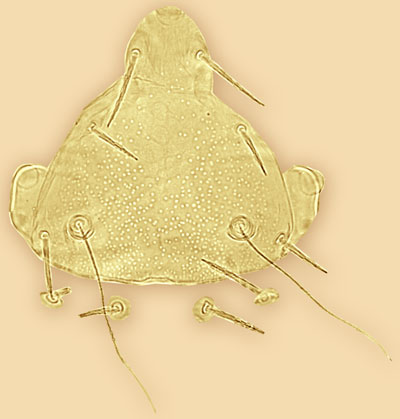
mite Neotrombidium sp. (Neotrobidiidae) ex Xylocopa micans from Florida
Fig. 1. Prodorsal sclerite, eyes, and anterior hysterosomal setae of the mite Neotrombidium sp. (Neotrombidiidae)
Back | Home | UMMZ Acari


Family Neotrombidiidae Feider, 1955


This family includes five genera (Feider, 1977; Krantz, 1978; Vercammen-Grandjean, 1973). Larvae are parasitic on Coleoptera, Diptera, and rarely on Hymenoptera (our data), while postlarval stages, including adults, live in forest litter and under bark of trees where they presumably prey on other small arthropods. The family is worldwide in distribution, excluding boreal and polar regions (Lindquist and Vercammen-Grandjean, 1971; Singer, 1971).
Description. Palpal genu with one seta. One pair of dorsal trichobotria on prodorsal sclerite. Scutellum bearing setae c1 absent. Claparede's organ present. Postero-apical corner of at least posterior coxa with distinct reticulate pattern. Femur I with at least one solenidia and seven pilose setae. Femora II-III with at least two solenidia. Only one empodial claw present on each tarsus.

Genus Neotrombidium Leonardi, 1902


Trombidium (Neotrombidium) Leonardi, in Berlese and Leonardi, 1902: 18 (Type Trombidium (Neotrombidium) furcigerum Leonardi, in Berlese and Leonardi, 1902 by monotypy).
Neotrombidium: Lindquist and Vercammen-Grandjean, 1971; Singer, 1971.

This genus includes 16 species distributed worldwide (Beron, 1995; Lindquist and Vercammen-Grandjean, 1971; Singer, 1971). Larvae are parasitic on unrelated families of subcortical Coleoptera: Cerambicidae, Elateridae, and Cleridae (Lindquist and Vercammen-Grandjean, 1971). We found a single larva of this genus on the bee Xylocopa micans. Level of association of this mite species with the host , thus, is unknown.
Description. Femur subdivided onto telo- and basifemur. See Lindquist and Vercammen-Grandjean (1971) for other characters.

Neotrombidium sp.

Material. USA: Florida, Alachua Co., Gainesville, soft membrane of hind coxae of female of Xylocopa micans Lepeletier, 1841 (Hymenoptera: Apidae), 4 May 1928, Alexander-Walker, UMMZ BMOC 03-0525-002.
Description. Uropore absent. Terminal setae of palpotarsus not different from other setae of palpotarsus, pectinate. Anterior sternal setae not fused with coxal fields I. Two nude genualae on leg I. Femoralae III not reaching apex of genu. Genuala III almost reaching apex of tibia.
Biology. A single larva was found attached to the soft membrane in the region of hind coxae of the bee host.
Distribution. USA: Florida.
Hosts. Xylocopa micans.

References
Berlese A., Leonardi G. 1902. Acari sud americani. Zoologischer Anzeiger. 25: 12-18.
Beron, P. 1995. A new larval species of Neotrombidium (Acariformes, Actinedida: Neotrombidiidae) from Cuba. Historia Naturalis Bulgarica. 1995: 13-18.
Feider Z. 1977. Quelques acariens cavernicoles de Cuba de la super-famille Trombiculoidea. In: T. Orghidan, A. Núñez Jimenez et al. (Eds.). Résultats des expéditions biospéologiques cubano-roumaines à Cuba. 2. Institut de Spéologie "Emil Racovitza" Romania. 201-208.
Krantz G. W. 1978. A manual of acarology. 2nd ed. Oregon State University Book Stores, Corvallis. 509 pp.
Lindquist E.E., Vercammen-Grandjean P.H. 1971. Revision of the chigger-like larvae of the genera Neotrombidium Leonardi and Monunguis Wharton, with a redefinition of the subfamily Neotrombidiinae Feider in the Trombidiidae (Acarina: Prostigmata). Canadian Entomologist. 103: 1557: 1590.
Singer G. 1971. Neotrombidium Leonardi (Acarina: Trombidioidea) Part I: Revision of the genus, with description of two new species. Acarologia. 13(1): 119-142.
Vercammen-Grandjean P.H. 1973. Sur les statuts de la famille des Trombidiidae Leach, 1815 (Acarina: Prostigmata). 15(1): 102-114.


B. OConnor and P. Klimov ©
Created: Dec 26, 2003
Last modified: