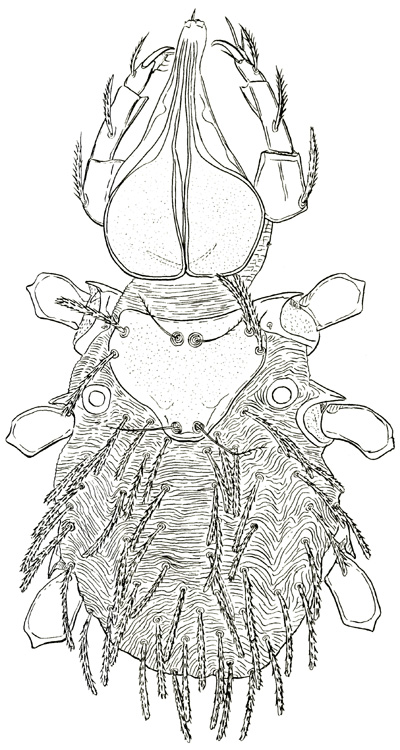
Fig. 1. Leptus ariel (Erythraeidae): larva, dorsal view (modified from Southcott, 1989) |
Bee Mites :
Acari :
Acariformes :
Trombidiformes
Family Erythraeidae Robineau-Desvoidy, 1828
This family includes 33 genera grouped in five subfamilies (Vercammen-Grandjean, 1973). Larvae of many these genera are ectoparasites of insects, millipedes, or arachnids, whereas postlarval instars are predatory. One genus, Leptus, occurs on bees.
Genus Leptus Latreille, 1796
Leptus Latreille, 1796: 177 (after Southcott, 1961; the year of the original description is 1756 after Vercammen-Grandjean, 1973) (type species Acarus phalangii DeGeer, 1778 nom. illegit. by subsequent designation)
(for synonymy and discussion about the type species designation see Southcott, 1961 and 1992)
Larvae of Leptus are known to parasitize different terrestrial arthropods. Two described species of this large genus occur on bees: Leptus ariel Southcott, 1989 has been found on the European honey bee in Guatemala. Leptus monteithi Southcott, 1993 has been described from a colletid bee Leioproctus sp. (Hymenoptera: Colletidae) from Australia (Tasmania). Two unidentified species were reported from the European honey bee in Peru (Cerro de Pasco) and Colombia (Fletchtmann, 1980; Losada, 1947; Southcott, 1989; 1993).
Leptus ariel Southcott, 1989
Leptus ariel Southcott, 1989: 124, Figs 3-5; Southcott, 1992: 29; Haitlinger 1999: 156.
Leptus sp. Wilson et al., 1987: 853.
Biology. Larvae were found attached to the hind femur, front head, and first metasomal tergite of the European honey bee Apis mellifera L. (Hymenoptera: Apidae). Since no adult mites were seen in the bee brood, it was assumed that mite propagation occurs outside the hive. The larval mites may have gained initial contact with the host while the bees were foraging on floral parts or while standing on moist soil investigating water. Observations within the hive did not reveal any obvious damage to the adult bees (Southcott, 1989; Wilson et al., 1987). Haltinger (1999) has found this species on a chrysomelid beetle in Peru.
Distribution. Guatemala (type locality); Peru (Haitlinger, 1999; Southcott, 1989).
Hosts. European honey bee, Apis mellifera L. (Hymenoptera: Apidae) (type host); Eumolpinae (Coleoptera: Chrysomelidae) (Haitlinger, 1999; Southcott, 1989).
References
Fletchtmann C. H. W. 1980. Dois Acaros associados a abelha Apis mellifera L. no Peru. Anais da Escola Superior de Agricultura "Luiz de Queiroz". 37: 737-741.
Haitlinger R. 1999(2000). Four new species of Leptus Latreille, 1796 (Acari, Prostigmata, Erythraeidae) from Peru. Museo Regionale di Scienze Naturali Bollettino (Turin) 17(1): 149-162
Losada B. S. 1947. Nuevas especies para Colombia: localizadas por primera vez por la secci—n de entomolog’a. Revista Facultad Nacional Agronom’a, Medell’n. 7(27): 325-332.
Southcott R. V. 1961. Studies on the systematics and biology of the Erythraeoidea (Acarina), with a critical revision of the genera and subfamilies. Australian Journal of Zoology. 9(3): 367-611.
Southcott R. V. 1989. A larval mite (Acarina: Erythraeidae) parasitizing the European honey bee in Guatemala. Acarologia. 30(2): 123-129.
Southcott R. V. 1992. Revision of the larvae of Leptus Latreille (Acarina: Erythraeidae) of Europe and North America, with descriptions of post-larval instars. Zoological Journal of the Linnean Society.105: 1-153.
Southcott R. V. 1993. Larvae of Leptus (Acarina: Erythraeidae) ectoparasitic on higher insects of Australia and New Guinea. Invertebrate Taxonomy. 7: 1473-1550.
Vercammen-Grandjean P. H. 1973. Sur les status de la famille des Trombidiidae Leach, 1815 (Acari: Prostigmata). Acarologia. 15(1): 102-114.
Wilson W. T., Wooley T. A., Nunamaker R. A., and Rubink W. L. 1987. An Erythraeid mite externally parasitic on honey bees (Apis mellifera). American bee journal. 127: 853-854.
B. OConnor and P. Klimov ©
Created: Dec 27, 2003
Last modified: